Why does broad targeting work better than lookalikes for high-ticket B2B ads?
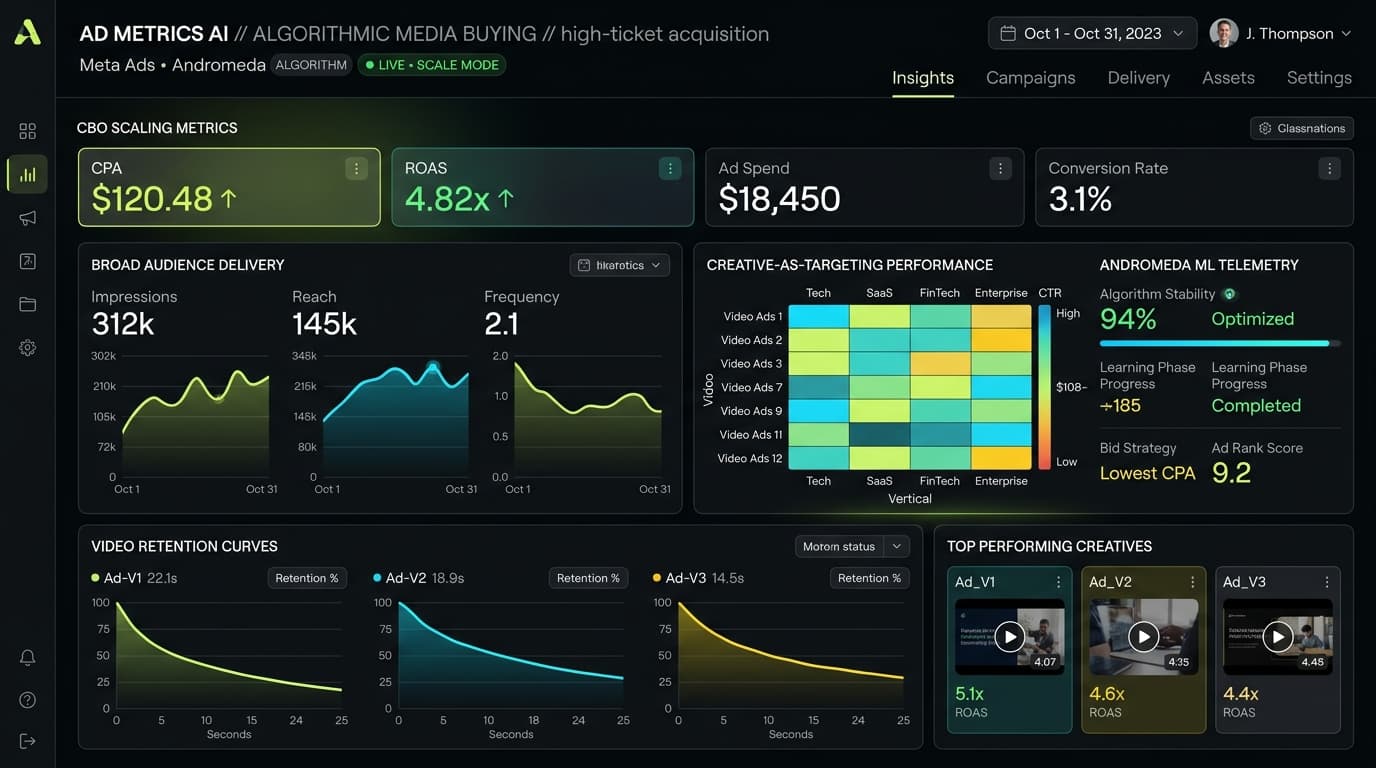
Broad targeting on Meta outperforms narrow lookalike audiences because Meta's Andromeda recommendation engine uses the creative assets (video script, on-screen text, transcript audio) to identify and deliver ads directly to receptive decision-makers, eliminating the audience fatigue and rising CPMs inherent in small audience pools.
- Narrow interest stacks restrict machine learning and cause rapid frequency fatigue.
- Your video hook and script language act as the demographic filter: speaking specifically to founders naturally excludes consumers.
- Broad audiences allow Meta's auction to secure the lowest possible CPMs while optimizing for qualified conversions.
Many B2B agency owners and consultants still run Meta Ads using outdated 2021 playbooks: stacking 15 job title interests, layering 1% lookalikes, and constantly rotating audiences every 7 days. In this media buying training breakdown, we analyze how Meta's modern Andromeda machine learning algorithm makes creative assets your primary targeting engine.
1. The Shift: How Andromeda & Machine Learning Rewrote the Rules
Algorithmic Delivery Over Manual Stacking
Meta processes hundreds of millions of contextual signals in real time. When you upload a video ad, natural language processing and computer vision transcribe your audio, scan on-screen captions, and analyze viewer engagement down to the millisecond.
If your video opens with: 'If you run a B2B consulting firm billing between $20K and $100K a month...', the algorithm immediately observes which users stop scrolling. Within 48 hours, Meta identifies the exact behavioral fingerprint of your ideal buyer without requiring manual audience restrictions.
2. The 'Creative-As-Targeting' Framework
Filtration Engineered into Creative Copy
Under the modern paradigm, your creative is your targeting. You no longer need an interest category for 'Chief Information Officer' or 'SaaS Founder'. Instead, you engineer your creative elements to naturally filter the viewer pool:
- The Visual Backdrop: Professional office environments, high-end production, or relatable screen shares automatically signal high production value to executives.
- The Semantic Barrier: Using sophisticated industry nomenclature ('churn reduction', 'pipeline velocity', 'LTV:CAC') naturally bores consumers while gripping decision-makers.
- Explicit Callouts: Directly vocalize who the solution is intended for in the first 4 seconds to repel unqualified impressions.
3. First-Party Case Benchmarks: Broad vs. Lookalike Performance
Real Account Data Across $50M+ Spend
In our testing across 30+ B2B verticals, broad targeting consistently yields a 38% lower cost per booked sales call compared to 1% lookalike audiences. While lookalikes initially generate low cost per clicks, they exhaust within 14 to 21 days as ad frequency escalates beyond 3.5.
Broad targeting sets, by comparison, operate across millions of prospective users, enabling Meta to continuously discover new high-intent buyers as their immediate need arises.
In a high-ticket MedSpa marketing account, broad targeting maintained a stable $0.50 CPL across 2,064 leads over 60 days, whereas lookalike ad sets saw CPL increase from $1.20 to $4.80 over the same duration.
4. Building the 3-Layer Creative Testing Engine
Systematic Creative Production
To dominate broad targeting, an agency must produce a regular stream of diverse creative formats: direct-to-camera founder breakdowns, live client dashboard proof walks, high-contrast typography carousels, and whiteboard mechanism teardowns.
By deploying 5 to 10 net-new creative variations weekly, you feed Meta's machine learning engine the raw material it needs to discover distinct buyer segments across the feed.
Strategic Conclusion
Relying on manual targeting stacks on Meta in 2026 is like driving with the handbrake engaged. By embracing broad creative-as-targeting, high-ticket agencies and consultants tap into Meta's full computational power, securing cheaper CPMs, eliminating ad fatigue, and filling calendars with qualified buyers.
Common Questions Answered
What is broad targeting in Meta Ads?
Broad targeting is an advertising approach where you leave age, gender, and interests open (or minimally restricted by geography), allowing Meta's machine learning algorithm to find your buyers based on creative engagement and conversion telemetry.
Do Meta Ads work for high-ticket B2B services?
Yes. Decision-makers and business founders spend significant daily time on Instagram and Facebook. With proper qualification funnels and executive-grade creative, Meta ads consistently out-convert LinkedIn ads on a cost-per-booked-call basis.
How does broad targeting prevent unqualified leads?
Filtration is built directly into the video hook, copy, and landing page survey. By stating minimum revenue requirements upfront and utilizing a 4-tier qualification form, non-buyers are eliminated before calendar access.
How much budget is needed to test broad B2B Meta Ads?
A healthy testing budget starts at $50 to $100 per day to provide Meta's pixel and Conversions API enough event volume to exit the learning phase within 7 to 14 days.
QualifiedLeadsX™ Research Team builds and scales customer acquisition funnels for elite high-ticket coaches, consultants, and growth agencies. Over $150M+ in client revenue scaled across North America, Europe, and the Middle East.